

Quick answer: A tow you call for yourself has no state price cap in Texas. A tow you did not ask for does. The Texas Department of Licensing and Regulation (TDLR) caps a light-duty private property tow at $272. Inside Dallas city limits, the cap drops to $165. Storage at an impound lot adds up to $22.85 a day.
That single split between tows you request and tows done to you explains most “I got ripped off” stories. This guide shows which prices the law sets and which it leaves open. It also explains how we quote our own jobs.
Key facts at a glance
- A consent tow is any tow the owner or driver calls for. Texas law sets no maximum price for it.
- A private property tow removes a car from a lot without the owner’s permission. TDLR caps it at $272 for vehicles 10,000 lbs or less.
- The City of Dallas caps the same tow at $165 when it starts inside Dallas city limits.
- Impound lots can charge up to $22.85 per day for storage, a $22.85 impound fee, and a $50 notice fee.
- You have 14 business days to request a tow hearing if a nonconsent tow was wrong or overcharged.
Consent vs. nonconsent tows: why one price is capped and one is not
Texas law sorts every tow into two groups. Your bill depends on which group your tow falls into.
A consent tow is one the owner or driver summons, under Texas Occupations Code §2308.002. You broke down, you called, you agreed to a price. The state treats that as a normal business deal.
A nonconsent tow is any tow the owner did not ask for. The statute names two kinds:
- Private property tows. A lot owner has your car removed from an apartment complex, store, or office lot.
- Incident management tows. A tow truck is sent to a crash or road incident, usually by police.
Here is the part most people miss about Texas tow prices. The state fee caps apply only to private property tows. Section 2308.0575 tells TDLR to set maximum fees for those tows.
That section sets no price limit at all for consent tows. Crash tows get their fees from the city where the tow started, under Section 2308.202.
So a $300 bill can be illegal on an apartment lot and perfectly legal on I-635. The car and the truck are the same, but the law is not.
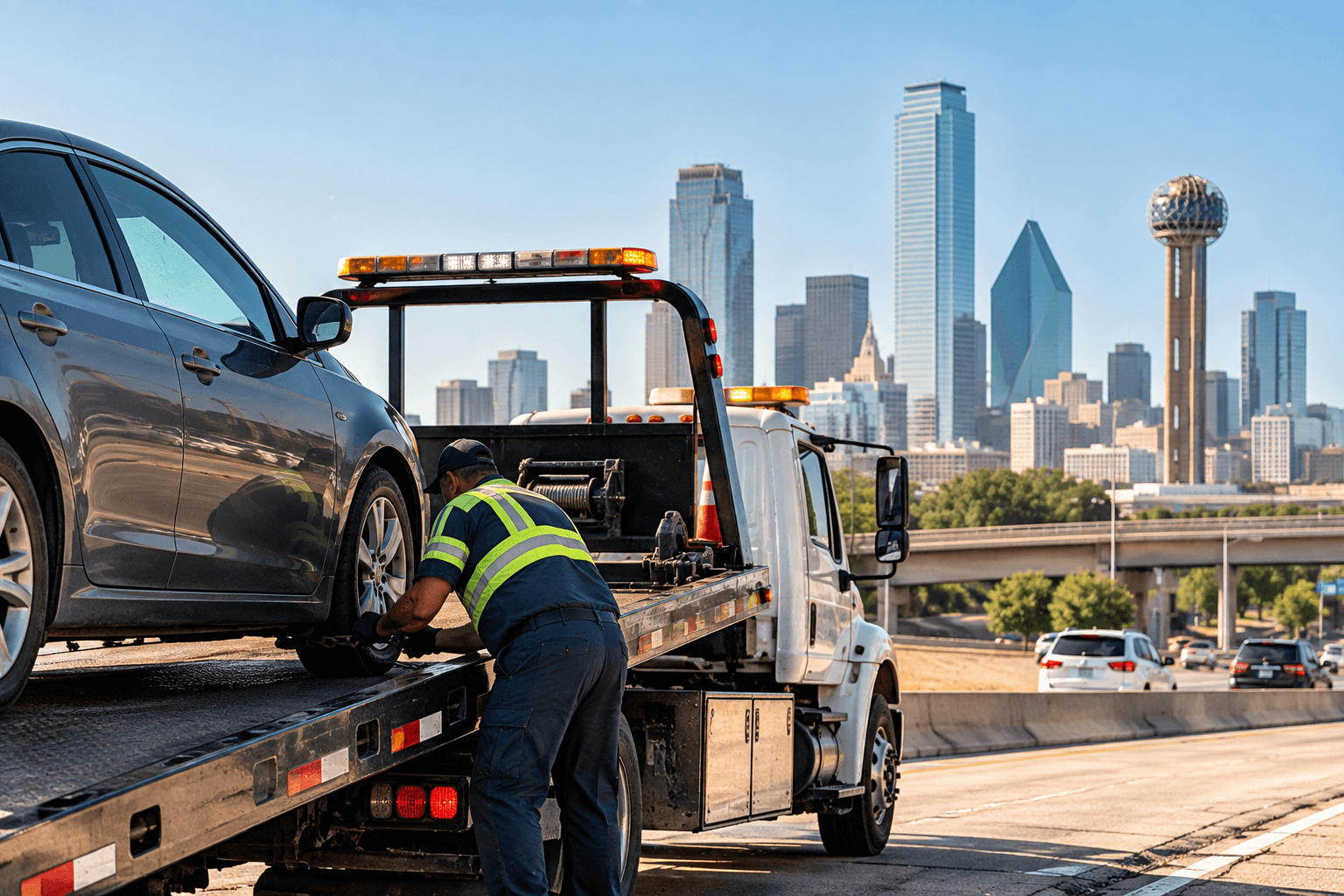
TDLR maximum tow fees for private property tows in Texas
TDLR sets the statewide ceiling for private property tows. Cities and counties can set a lower number, but never a higher one. These are the current maximums from TDLR’s fee page, as of September 2026:
| Vehicle weight | Max tow fee | Max drop fee |
| 10,000 lbs or less (cars, SUVs, pickups) | $272 | $135 |
| 10,001 to 24,999 lbs | $380 | $190 |
| 25,000 lbs or more | $489 per unit, $978 total | $244 |
A drop fee applies when you catch the truck before it leaves the lot. According to TDLR’s consumer guide, the rules work like this:
- Car not fully hooked up yet: The driver must release it, and you pay nothing.
- Car fully hooked up but still on the lot: You can take it back by paying the drop fee.
- Payment: The driver must accept cash, credit cards, and debit cards.
A towing company also cannot invent extra charges. Under 16 TAC §86.458, any fee not on the approved nonconsent list is off limits. TDLR can order a refund of any overcharge.
Towing prices inside Dallas city limits are capped lower
The City of Dallas sets its own private property tow caps, and they sit below the state numbers. Dallas City Code §48A-43 currently allows:
| Vehicle weight | Dallas max tow fee |
| 10,000 lbs or less | $165 |
| 10,001 to 24,999 lbs | $300 |
| 25,000 lbs or more | $489 per unit, $978 total |
Dallas also bans extra charges for hookup, dollies, or go-jacks. The tow company must let you pay by cash or major credit card.
Two warnings before you use these numbers:
- City limits matter, not the mailing address. The Dallas cap applies only when the tow starts inside the City of Dallas. A lot in Mesquite, Garland, or Balch Springs follows that city’s rule. If the city has no lower rule, the $272 state cap applies.
- Many websites still quote old numbers. You will find $121 on some pages and $272 on others. The $165 figure comes from the city’s current code, updated by Ordinance 33232.
The Dallas ordinance also exempts tows you arrange yourself, under §48A-4. That exemption matches state law. When you call a tow yourself, the price is yours to negotiate.
Impound fees in Texas: storage, impound, and notice charges
Once a nonconsent tow reaches a vehicle storage facility (VSF), a second set of caps kicks in. TDLR updates these every two years based on inflation. As of September 2026, TDLR lists these maximums:
| VSF charge | Maximum | When it applies |
| Daily storage, 25 ft or shorter | $22.85 per day | Each day or part of a day |
| Daily storage, over 25 ft | $39.99 per day | Each day or part of a day |
| Impound fee | $22.85 one time | Only if the lot inventories, tarps, or runs registration |
| Notification fee | $50 one time | Only if the lot sends the required owner notice |
| Government fee | Actual amount | Only fees owed to a law enforcement agency |
A few rules cut these charges down:
- A day starts and ends at midnight. A car held under 12 hours pays only one day.
- The lot cannot charge the $50 notice fee if you pick up the car within 24 hours.
- The lot cannot charge environmental fees, notary fees, or a fee to get your belongings.
What a weekend impound can cost
Say your car is towed from a lot outside Dallas at 11 p.m. Friday. You pick it up from the lot at noon on Sunday.
Here is the most the law allows for that weekend:
- Tow fee: $272
- Storage for Friday, Saturday, and Sunday: $68.55
- Impound fee, if the lot earned it: $22.85
- Notice fee, if the lot mailed notice: $50
Worst-case total: $413.40. The same tow starting inside Dallas city limits tops out at $306.40.
If your bill is higher than these totals, something is wrong. Ask for the itemized tow ticket and check each line against these tables.
Police-ordered tows after a crash in Dallas County
Crash and police tows are nonconsent tows, but TDLR’s $272 cap does not cover them. Each city sets its own rates for these incident management tows.
In Dallas, police tows go to the Dallas Auto Pound or one of two Peak Auto Storage lots. The Dallas Police Department posts the lookup number, (972) 430-6200, for location and fees.
You need proof of insurance to drive the car out of the Dallas pound. Without proof of insurance, the car must leave the pound on a tow truck.
In Mesquite, police send the city’s contract wrecker when a wrecked car cannot be driven. Mesquite PD policy lets the driver negotiate with that wrecker to go somewhere other than the city pound. If you have a preferred body shop, say so at the scene.
If you are able to call a tow yourself after a minor crash, that tow becomes a consent tow. You choose the company, and you agree on the price first. Our emergency towing team handles accident calls across the county.
What drives the price of a tow you call for
No state cap applies to a consent tow, so the price comes from the job itself. These factors move the number most:
- Hookup or base fee. Most companies charge a flat fee to dispatch the truck and load the car.
- Distance. Miles to the shop, dealer, or your home usually carry a per-mile rate.
- Truck type. All-wheel-drive, lowered, and damaged cars often need a flatbed. See which vehicles need a flatbed before you call.
- Recovery work. A car in a ditch or a tight parking garage takes winching or extra time.
- Vehicle weight. A heavy work truck needs a bigger truck than a sedan does.
Storage works differently on a consent tow as well. The Texas Towing and Storage Association says TDLR storage rules do not apply to consent storage. Ask about storage costs before a car sits at any shop or yard.
The best protection on a consent tow is simple. Get the total price before the truck leaves the yard, and get it in writing by text if you can.
How we price towing in Mesquite and Dallas County
We quote every job before we send a truck. If the number does not work for you, you have lost nothing but a phone call. The quote is free, and you owe nothing until you agree to it.
Three things set the price of our quote:
- The service you need. A roadside fix and a tow are priced differently. Flatbed towing suits all-wheel-drive, lowered, and damaged cars.
- Where your vehicle is. The pickup spot and the drop-off spot both shape the quote.
- What you drive. We tow cars, pickups, SUVs, motorcycles, and light commercial vehicles.
A few more things stay the same on every call:
- One rate around the clock. Time of day does not change what we charge, so a 2 a.m. call costs the same as a 2 p.m. call.
- Insurance and warranty tows. Tell us on the call, and have your claim or policy details ready. We can take your car to the dealer, body shop, or insurance lot.
- Fleet accounts. Businesses with several vehicles can set up an account with us.
Some breakdowns do not need a tow truck at all. A dead battery calls for a jump start, and keys locked inside call for car lockout help. Both fall under our roadside assistance service.
We dispatch from Mesquite and cover the cities on our towing coverage area page. That includes towing in Mesquite, towing in Dallas, and towing in Balch Springs.
How to dispute a tow bill in Texas
You can challenge a nonconsent tow in court and with TDLR. Start with the tow ticket, since Texas requires one for every nonconsent tow. It must list each charge and the operator’s TDLR license number.
- Request a tow hearing. File a written request at a justice court in the county the car was towed from. You have 14 days, not counting weekends and holidays, under Section 2308.456.
- Bring proof. Include your receipt and photos of any parking signs. If no sign was posted, say so in writing.
- Know what the judge decides. The court decides if the tow had probable cause. It also decides if the charges broke the cap, under Section 2308.458.
- File a TDLR complaint. Use the TDLR complaint form. A complaint does not replace the hearing, but you can do both.
The court may charge a $20 filing fee. The hearing must happen within 21 days after the court gets your request.
Tow cost FAQs
What are the tow fees in Texas?
Texas tow fees depend on the tow type. TDLR caps a light-duty private property tow at $272, plus up to $22.85 per day of storage. Texas sets no cap on a tow you call for yourself, and crash tow rates come from the city.
How much does it cost to get a car out of impound in Texas?
Getting a car out of a Texas impound lot usually means paying the tow fee plus storage. For a private property tow, the maximum is $272 plus $22.85 per day. An impound fee of $22.85 and a $50 notice fee can apply in some cases.
Is a $300 tow in Dallas legal?
A $300 tow in Dallas can be legal or illegal. If you called for it, no cap applies, so the price is whatever you agreed to. If it was a light-duty private property tow inside Dallas city limits, the legal maximum is $165.
Do I have to pay the tow truck if I catch it in the lot?
You do not pay anything if the tow truck has not fully hooked up your car. If the car is fully hooked up but still on the lot, you pay a drop fee. The state maximum drop fee is $135 for a light-duty vehicle.
How do I find a car towed by Dallas police?
Call the Dallas Police Department’s towed vehicle line at (972) 430-6200. The line gives the car’s location, status, and fees. Bring photo ID and proof of insurance to the lot.
The bottom line on Dallas County tow costs
The law protects you when a tow is done to you. It leaves you to negotiate when you call for help.
First, figure out which kind of tow you are dealing with. Then check the bill against the caps above, and get a price before any truck rolls.
Need a tow in Mesquite or Dallas County right now? Call Around the Clock Towing at (214) 600-3312 for a free quote before we dispatch. You can also browse our full towing services in Dallas County or contact our team online.