

Quick answer: Most car batteries last three to five years, according to AAA. In Texas, plan on the short end of that range. Summer heat does the lasting damage inside the battery. The first cold mornings of fall simply expose it. If your battery is three or more years old, test it in September or October.
Most drivers blame the cold when their car won’t start in November. But the cold is only the last straw that breaks it.
The real damage happened back in August, while the car still started fine every day.
Key facts at a glance
- Heat, not cold, causes the permanent wear inside a car battery.
- Battery life drops by about half for every 15°F of steady heat above 77°F, per Battery University.
- DFW Airport averaged a 102.1°F daily high in August 2026, with 27 days at 100°F or hotter.
- Cold mornings cut a battery’s power, but the loss goes away when it warms up.
- DFW’s average first freeze falls on November 22, according to the National Weather Service.
Heat, not cold, does the lasting damage to a car battery
Heat speeds up the chemistry inside a lead-acid car battery. That extra speed wears the battery out faster. Two kinds of damage build up over a hot summer:
- Grid corrosion. The metal grid inside the battery rusts away faster in heat. Battery University lists this as a main reason lead-acid batteries age.
- Water loss. Heat pulls water out of the battery acid. AAA Oregon/Idaho says summer heat speeds up fluid loss and rust on battery parts.
Neither kind of damage goes away when the weather cools. Battery University says once heat harms a battery, the lost power cannot come back.
The battery industry uses a blunt rule of thumb. Every 15°F rise above 77°F cuts battery life about in half. Battery tester maker Midtronics uses the same 15°F guideline for car batteries.
AAA Texas says the same thing in plain words. A spokesperson told KXII in July 2026 that heat and vibration are a battery’s worst enemy.
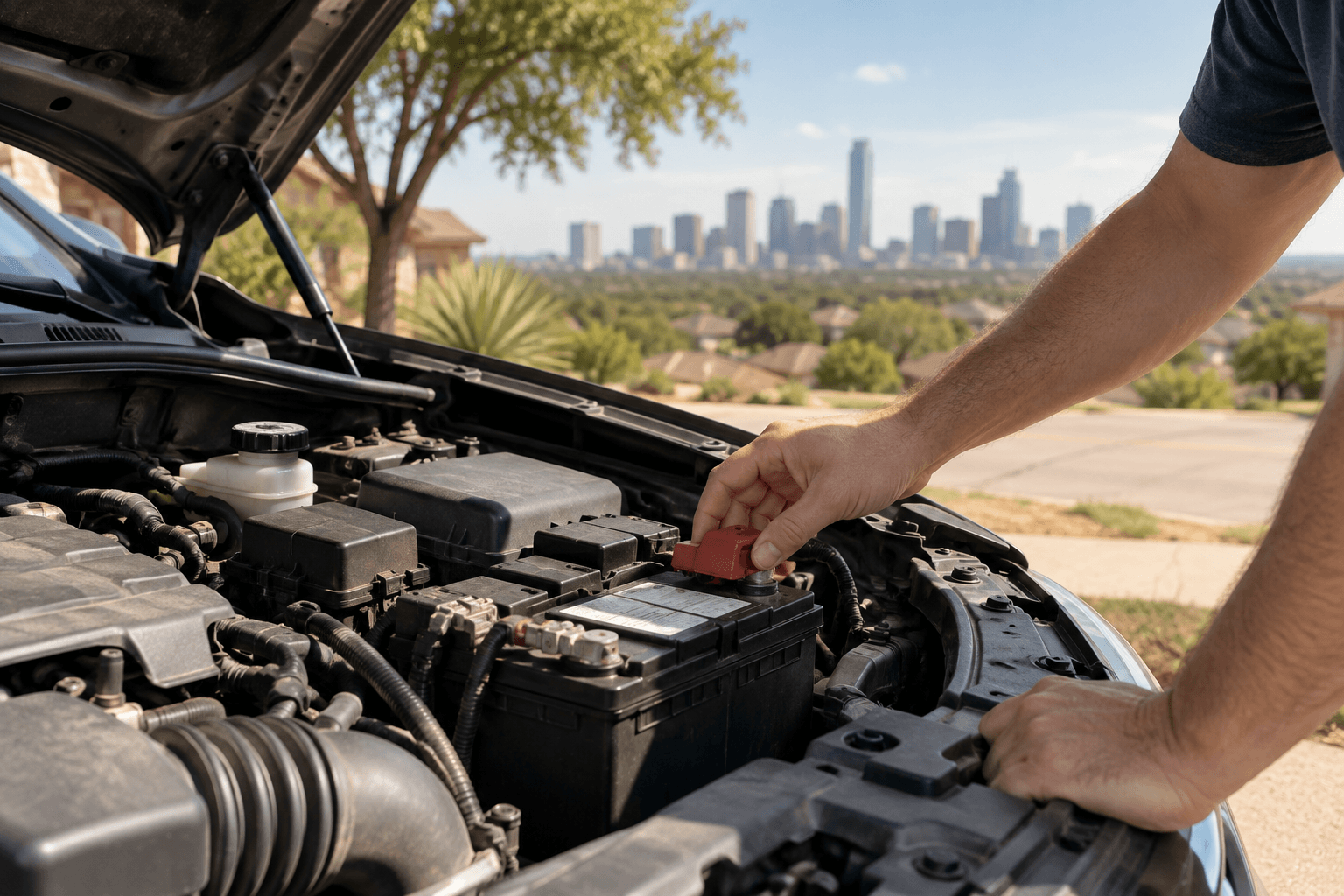
DFW’s summer of 2026 was hard on every battery in town
North Texas does not just get hot for a day. It stays hot for weeks at a time. Here is what the National Weather Service recorded at DFW Airport this summer:
| Month | Average daily high | Normal high | Days at 100°F or more |
| July 2026 | 97.9°F | 95.6°F | 10 |
| August 2026 | 102.1°F | 95.8°F | 27 |
August’s average, day and night combined, came out to 91.3°F. That is about 14°F above the 77°F sweet spot for a car battery. And the air under your hood runs hotter than the air outside.
A battery can live through a summer like that and still start your car every morning. The damage stays hidden because a warm battery cranks well. That hidden damage is the trap.
Why a heat-damaged battery quits on the first cold morning
Cold weather does not destroy a healthy battery. It only lowers the power the battery can give while the cold lasts.
Battery University explains that cold makes it harder for power to flow out of a battery. A battery with full power at 80°F gives only about half at 0°F. Cold motor oil is thicker, so the engine is also harder to turn.
Now put those two facts together:
- Summer shrinks the battery’s reserve. Heat corrosion and water loss eat into its capacity for good.
- Warm weather hides the loss. A weak battery still has enough power to start a warm engine.
- The first cold morning removes the cushion. Less power meets a harder start, and the engine just clicks.
In North Texas, that first real test usually comes in late fall. The National Weather Service lists November 22 as DFW’s average first freeze. Mornings in the 30s and 40s start weeks earlier.
What that looks like on a real morning
Your car started fine on Friday afternoon at 85°F. Monday morning it is 38°F in the driveway. You turn the key and hear a slow crank or a click.
The battery did not fail over the weekend. It failed in August, and Monday was the day the margin ran out.
How long car batteries last in Texas
AAA says most car batteries have a three-to-five-year service life, even with good care. Where you live changes where you land in that range, and heat pulls you low.
Battery Council International (BCI), the battery trade group, has tracked dead batteries for decades. Battery University reports that BCI’s failure studies found batteries in warmer climates die sooner than batteries in the northern U.S.
For a daily driver in Dallas County, a simple plan looks like this:
- Years one and two: Most batteries run fine.
- Year three: Get a load test before cold weather arrives.
- Years four and five: Test every fall, and set money aside for a new one.
Warning signs your car battery is losing strength
A heat-damaged battery often gives small warnings before it dies. Watch for these signs:
- Slow cranking. The engine turns over lazily, especially on cooler mornings.
- Clicking when you turn the key. The starter gets too little power to spin.
- Dim headlights at idle. Lights brighten when you rev the engine.
- A battery warning light. The dash light can point to a battery or charging problem.
- A swollen or leaking case. Heat can bulge the battery case, so replace a swollen battery right away.
- Age. Look for the date sticker or code on the battery case. Three years or older puts it in the risk zone.
Test your battery now, not at 6 a.m. in a parking lot
Testing a car battery only takes a few minutes. Buying a new one on your own time beats waiting for it to strand you.
You have two easy ways to get it done:
- Free test at a parts store. Many auto parts stores test batteries for free. The O’Reilly store in Mesquite, for example, tests batteries and alternators at no charge.
- Test on a service call. When we jump start a car on a roadside assistance call, we test the battery before we leave. If it will not hold a charge, we can replace it.
Yes, we just told you how to avoid calling us. We would rather you remember us as the people who told you to check it first.
What to do if your car battery dies anyway
If your car will not start, a jump start is usually the first step. It gets the engine running so you can reach a store or shop.
A jump does not repair heat damage, though. The battery may die again within days.
Before any jump, take a quick look at the battery case. AAA warns drivers not to jump a battery that is bulging, cracked, or leaking.
Our jump start service handles the whole job on site. We jump the car and test the battery. If it will not hold a charge, we can replace it on the spot.
If the car still will not start, the starter or alternator may be the problem. Our emergency towing team can take it to your shop.
Car battery FAQs for Texas drivers
Does heat kill car batteries faster than cold?
Yes, heat kills car batteries faster than cold. Heat causes lasting rust and water loss inside the battery. Cold only lowers the power a battery can give while it stays cold.
Why did my car battery die when it got cold?
Your car battery likely died in the cold because summer heat had already weakened it. Cold weather cuts the power a battery can give. A healthy battery has enough reserve to cover that loss, but a weak one does not.
How often should I test my car battery in Texas?
Test your car battery once a year starting at year three. Early fall is the best time in Texas, after the summer heat and before the first cold snap. Test sooner if you notice slow cranking or dim lights.
Can a jump start fix a heat-damaged battery?
No, a jump start cannot fix a heat-damaged battery. A jump only borrows power to start the engine. The rust and water loss inside the battery stay put.
The bottom line on Texas heat and car batteries
August does the damage, and November sends the bill. If your battery has three or more Texas summers behind it, get it tested this fall.
Car won’t start in Mesquite or Dallas County? Call Around the Clock Towing at (214) 600-3312 for a jump start and a battery test. We can replace the battery on the spot if you need one. We cover Mesquite, Dallas, and every city on our coverage area page. You can also contact our team online for a free quote.